Markets · Union Post UK
I mpending doom is doing wonders for tinned food sales. Since the government urged Britons to stock up on emergency supplies, Iceland reported a 40 per cent increase in sales of its tinned products over the weekend. On Ocado, some bottled water and soups were out of stock.
And northern supermarket Booths also said sales of tinned goods, water and batteries were on the rise. The sudden enthusiam for Covid-esque stockpiling follows the government ’s new Be Ready campaign, encouraging households to keep three days’ worth of non-perishable food , bottled water and other miscellaneous survival gear in case of emergencies. All very sensible, though one does wonder when the collapse of civilisation is going to happen and what will be the cause of it.
Extreme weather? War? AI?
Whatever the politicians are not so subtly hinting at, I’d appreciate a little more notice before dinner. For someone who has spent years writing about the dangers of ultra-processed food, it was a somewhat humbling experience to find myself contemplating whether I could live off a packet of mini cheddars and tin of spam for a week. The challenge I had set myself was simple: could I survive on emergency food without a hob, oven or fridge?
Would I get enough protein, fibre and vitamins? Would I get scurvy? Would I die of boredom?
All legitimate concerns when faced with a pantry full of packet food. But as I wandered the supermarket aisles scrutinising ingredients and best-before dates, I started to wonder how hard it could be to make the food genuinely delicious. In truth, I became quite competitive about it.
Preparing for the apocalypse involves an extraordinary amount of shopping for very small things (Hannah Twiggs) The building blocks are easy enough. Tinned potatoes, beans, peas, sweetcorn and an impressive selection of fish. Rice comes ready-cooked in everything from Mediterranean to sticky sushi-style.
This might be a good time to invest in Uncle Ben’s. Long-life milk makes cereal and porridge perfectly manageable. But it quickly became clear that the most important purchases for a foodie in an apocalypse aren’t the tins at all.
They’re olive oil , chilli oil, whatever-flavour-you-like oil, vinegar, sriracha, mustard , honey, peanut butter , mango chutney and enough spices to see out a lengthy siege. A decent spice cupboard, it turns out, is worth far more to morale than another six tins of chickpeas. Apocalypse avo on toast Breakfast brought the first breakthrough.
Long-life milk is, well, fine. It’s sweeter and creamier than the fresh stuff, but after a few encounters I pretty quickly started to contemplate the virtues of fasting. What my Millennial blood was crying out for, was avocado on toast.
So I made it, sort of. Tinned peas mashed with olive oil, lemon juice and chilli, piled onto Ryvita. Apocalypse avo on toast, if you will.
It was the colour of 1940s austerity – all the tinned food was – but it tasted remarkably good. The peas had a lovely savoury sweetness to them and the chilli oil added a welcome kick. At around 80p a tin, I could almost forgive the absence of an actual avocado.
What started as a survival exercise quickly became a competition to make the best apocalypse lunch (Hannah Twiggs) Emboldened, I looked to the lunches I usually make for myself when someone isn’t invading the country. A Nicoise salad seemed an obvious candidate: tinned tuna and anchovies are already part of the recipe, so why not tinned potatoes and green beans? It worked beautifully, and a sharp mustard vinaigrette dealt with the unmistakable preserved taste of the vegetables.
Discovering that fresh garlic can last for months if stored properly was a useful lesson, since jarred garlic won’t keep outside of the fridge. My poke bowl was another success. I make it with tinned salmon, and adding tinned mango, tinned peas, a sachet of pickled ginger (nicked from Itsu) and crumbled nori with a dressing of soy sauce, sesame oil, honey and sriracha brought it very close to the original.
Though nothing beats freshly cooked rice. The ready-cooked packet kind is technically edible, though more akin to endlessly chewing paper kernels. Soaking it briefly in drinking water helps, though using it to improve the texture of rice might not be the most sensible decision during an actual national emergency.
At some point, I realised I was taking the enterprise far too seriously. I’m not officially recommending leaving your next sushi dinner with a fistful of sachets, though they are very helpful. Tomato puree sachets should certainly be on your list – the tubes won’t keep out of the fridge.
It turns out that preparing for an apocalypse involves an extraordinary amount of shopping for small things. Protein is also a challenge. Tinned fish is plentiful – providing you like fish.
Meat is rather less inspiring. Corned beef, ham and Spam are easy to find, but chicken largely comes in an ambiguous “white sauce” that has the consistency of snot. But, in what could be considered a fleeting moment of madness, I wondered whether the sauce could actually be the magic ingredient.
In lieu of things like mayonnaise and boiling water for stock, it was a struggle to make my apocalypse menu saucy instead of merely oily or dry. The humble tin can keep you fed for years – though what’s inside isn’t always particularly inspiring (Hannah Twiggs) So I got creative. If we are to return to wartime rationing, coronation chicken, invented in 1953, seemed thematic, if not mildly insane.
An overly generous helping of curry powder (top apocalypse store-cupboard ingredient), mango chutney, raisins and bottled lemon juice went in. I kept tasting and adjusting until something remarkable happened. It became coronation chicken.
Really good coronation chicken, too. Spoon it onto Ryvita and you’ve got a perfectly respectable lunch. Admittedly, I am disproportionately proud of this achievement.
A vegetarian surprise Poor vegetarians. Surviving on a week’s worth of tinned vegetables isn’t a promising assignment, gastronomically or gastrointestinally, for anyone. Shelf-stable silken tofu, which can last for six months to a year before opening, goes well with jasmine rice, peas and a peanut butter “satay” dressing.
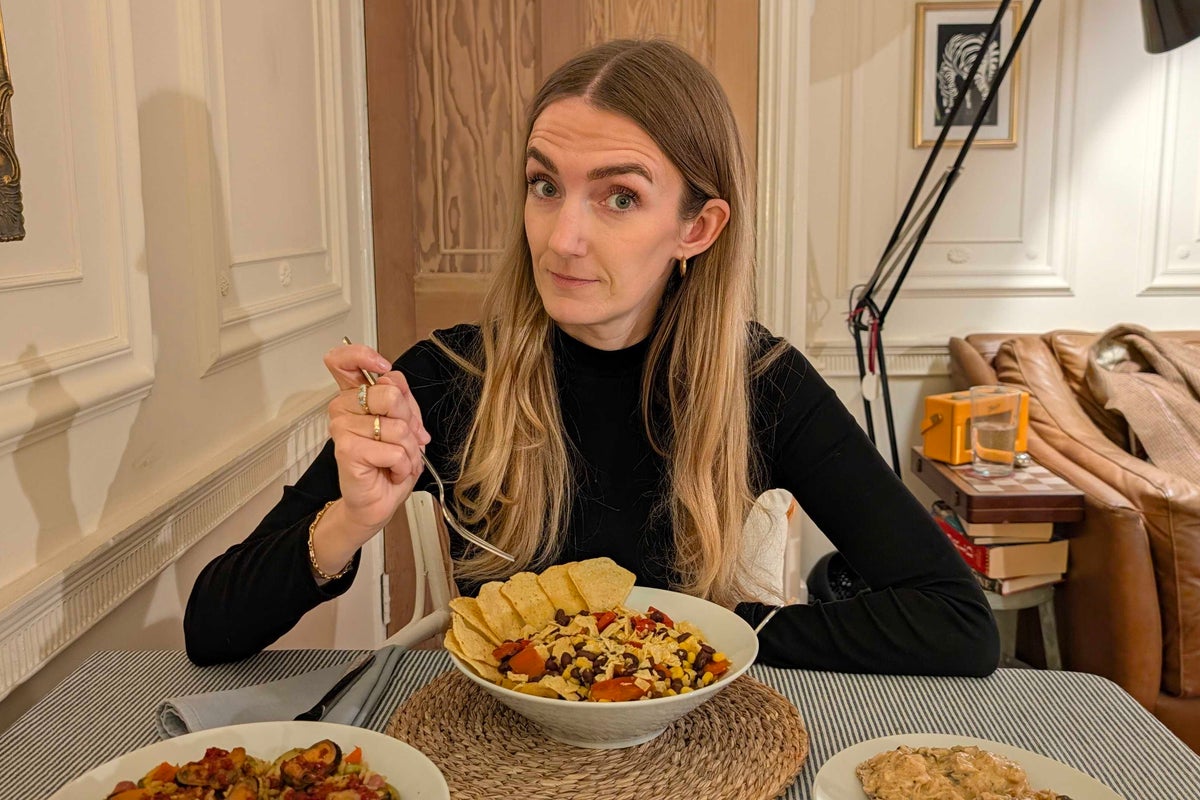
Silken tofu is a little difficult to handle and a strange texture to stomach but it’s an excellent vehicle for soaking up flavour and adding a bit of protein to the bowl. My Mexican bean salad was less successful. Not that it wasn’t delicious – lime, Tabasco, smoked paprika, tortilla crisps crumbled over the top – but there’s only so much of a bowl almost entirely composed of beans you can enthusiastically get through.
Variety is rather more important. A paella (of sorts) My mum lives in Spain, so paella is close to my heart, although what follows probably constitutes a diplomatic incident. In the back of my cupboard has long sat a tin of smoked mussels.
I can’t remember from where and have never made the substantial effort of opening them, but now was their time to shine. Their smokiness reminded me of paella, which made me think of chorizo, which led me to wonder what might serve as a substitute. Enter Peperami: individually wrapped, long-lasting and with just enough chorizo-ness that you won’t need to build a meat larder in your basement.
I chopped a few little sausages up and mixed them with Mediterranean-style rice, roasted peppers from a tin, peas and a dressing of tomato puree, olive oil, lemon juice and plenty of smoked paprika. It was terrific. Not paella – not technically – and I certainly wouldn’t recommend serving it to a Valencian.
But it was a genuinely enjoyable meal. Of course, even the finest apocalypse paella couldn’t disguise the fact that I was desperately missing hot food. Not just the warmth, but the textures that come with cooking.
Freshly cooked rice, crispy potatoes, sizzling bacon and something that crunches because it’s been fried rather than because it’s stale. And cheese. I belong to the school of thought that believes almost any meal can be improved by cheese.
This was the food that I missed the most in my fauxpocalypse experiment. The real heroes of the experiment: chilli oil, sriracha and enough seasoning to see out a lengthy siege (Hannah Twiggs) There was another problem I hadn’t properly considered: waste. Tins and jars and packets can last months, if not years, unopened, but most need to be put in the fridge once the seal’s broken.
Feeding one person without a fridge would mean eating an enormous quantity of the same ingredient, leaving it out and praying it won’t go off or throwing perfectly good food away. Fortunately, I had friends coming over for dinner towards the end of the experiment. We had intended to mark the occasion with a kebab and it had become such a fixture in my mind over the week that I would salivate at the thought.
But I decided to use up the remainder of what I had to make several dishes for us all to share, thereby avoiding the problem of half-empty tins and jars. I suspect they thought I’d lost the plot but came anyway, hopefully out of friendship rather than morbid curiosity. They were pleasantly surprised by the results of a mix of all of the above.
Feeding two, three or four people in an emergency is considerably easier than feeding one. Perhaps the answer to that problem is to form little apocalypse bubbles with the neighbours, which sounds a bit too Covid for comfort. Alternatively, you could start procreating, although that seems a fairly drastic solution to the problem of half a tin of sweetcorn.
A few practical lessons emerged too. A tin opener is essential, obviously, but so is a sieve for the extraordinary amount of draining you’ll be doing. If you’re smart, you’d use some of that excess for sauces and dressings to avoid using water.
But it’s worth keeping some aside for things other than drinking. Not just for bringing dry rice back to life, but for washing utensils and your hands. Fortunately, most of the meals can be assembled in the bowl, which keeps washing up to a minimum.
So, can you survive on emergency food? Yes, and probably for far longer than three days without much effort or expense, provided you’ve got enough of it and pay some attention to nutrition. The real question is, can you make it delicious?
Surprisingly, yes. I had some excellent meals, discovered a newfound appreciation for anything that comes in a tin and learnt that the difference between something utterly miserable and something pretty good can be a spoonful of mustard and a generous glug of olive oil. Would I want to eat like this indefinitely?
Absolutely not. There are only so many cold meals one can eat before fantasising about a baked potato topped with melted cheese. Nor would I suggest that a diet featuring Peperami, crisps and tinned chicken in a suspect sauce is the secret to eternal health.
But it will keep you alive if the electricity goes off. And if the apocalypse does come, you’re all welcome at mine for dinner. Handy ‘end of the world’ recipes to go...
Apocalypse avo on toast A surprisingly convincing alternative to avocado on toast, made with mashed tinned peas, olive oil, lemon and chilli. It won’t win any prizes for colour, but the flavour more than makes up for it. Serves : 2 Avocado was out, but mashed tinned peas turned out to be a surprisingly convincing substitute (Hannah Twiggs) Time : 5 minutes Ingredients : 1 300g tin garden peas, drained 2 tbsp extra virgin olive oil 1-2 tsp bottled lemon juice 1⁄2 tsp chilli oil, or a pinch of chilli flakes 1 clove garlic, crushed (or 1⁄2 tsp garlic powder) Salt and freshly ground black pepper 4 Ryvita crispbreads Method : 1.
Drain the peas and tip into a bowl. 2. Stir through the olive oil, lemon juice, chilli oil or flakes and garlic, and mash roughly with a fork, leaving some whole for texture. 3. Season generously with salt and black pepper, adding more lemon juice or chilli to taste.
The mixture should be chunky rather than completely smooth. 4. Pile onto the Ryvita just before eating, finishing with an extra drizzle of olive oil or chilli oil if you like. Salmon and mango poke bowl The tinned salmon and mango were easy wins.
Cold, ready-cooked rice was rather less successful (Hannah Twiggs) Tinned salmon, mango and pickled ginger make a surprisingly good approximation of a poke bowl. The dressing does much of the work, while the nori adds a welcome savoury flavour. Serves : 2 Time : 10 minutes Ingredients : 1 x 250g pouch ready-to-eat sticky rice 1 tin salmon, drained 1 tin or 2 individual pots mango in juice, drained and chopped 1 tin garden peas, drained 1-2 small sachet pickled sushi ginger 1 nori sheet, torn or cut into strips 1 tsp sesame seeds, optional For the dressing : 2 tsp sesame oil 1 tsp soy sauce 1 tsp rice wine vinegar 1⁄2 tsp honey 1⁄2-1 tsp sriracha, to taste Method : 1.
Empty the rice into a bowl and separate the grains with a fork. If it's particularly firm, briefly soak it in a little clean, cold drinking water, then drain thoroughly. 2. In a separate bowl, whisk together the soy sauce, sesame oil, rice vinegar, honey and sriracha.
Taste and adjust the balance of sweet, salty and spicy. 3. Arrange the salmon, mango and peas over the rice. 4. Add the pickled ginger and strips of nori, then drizzle over the dressing. 5.
Scatter with sesame seeds, if using, and serve. Coronation chicken crispbreads A generous helping of curry powder and mango chutney rescued chicken that initially smelled like dog food (Hannah Twiggs) The white sauce from tinned chicken makes an unexpectedly effective substitute for mayonnaise. A little curry powder, mango chutney and dried fruit transform it into something remarkably close to proper coronation chicken.
Serves : 2 Time : 5 minutes Ingredients : 1 400g tin cooked chicken in white sauce, suitable for eating cold 1 tsp mild curry powder, or more to taste 1 tsp mango chutney, or more to taste Handful of raisins 1 tsp bottled lemon juice, or more to taste Freshly ground black pepper 4 Ryvita crispbreads or oatcakes Method : 1. Empty the chicken and its white sauce into a bowl, breaking up any large pieces of meat with a fork. 2. Stir through the curry powder, mango chutney and raisins or dried apricots until well combined. 3.
Add the lemon juice and a generous grind of black pepper. 4. Taste and adjust the seasoning, adding more if needed, to taste. If the sauce is particularly thick, loosen with a teaspoon of clean drinking water. 5.
Spoon generously onto the crispbreads just before eating. Emergency cupboard Niçoise A French classic, recreated without boiling a single potato – and with surprisingly little compromise (Hannah Twiggs) A store-cupboard take on the French classic, using tinned potatoes and green beans instead of freshly cooked vegetables. A punchy mustard vinaigrette helps disguise their preserved flavour.
Serves : 2 Time : 10 minutes Ingredients : 1 400g tin new potatoes, drained and halved 1 400g tin green beans, drained 1 tin tuna in spring water or olive oil, drained 4-5 anchovy fillets 5-6 black olives, halved For the mustard vinaigrette : 2 tbsp extra virgin olive oil 2 tsp red wine vinegar 1⁄2-1 tsp Dijon mustard 1-2 small garlic clove, crushed, or 1⁄2 tsp garlic powder 1⁄2 tsp bottled lemon juice, optional Freshly ground black pepper Method : 1. Drain the potatoes and green beans thoroughly. Halve or quarter any larger potatoes. 2.
Whisk together the olive oil, red wine vinegar, mustard, garlic and black pepper. Add the lemon juice if you prefer a sharper dressing. 3. Toss the potatoes in half the vinaigrette, making sure they’re well coated. 4.
Add the green beans and olives and gently combine. 5. Flake the tuna into large chunks and arrange over the vegetables. 6. Lay the anchovy fillets on top and drizzle with the remaining dressing.
Finish with black pepper. Peanut-sriracha satay rice with silken tofu Shelf-stable tofu proved an unlikely success, particularly when smothered in peanut sauce (Hannah Twiggs) Shelf-stable tofu makes an excellent vegetarian protein for an emergency cupboard. Its delicate texture works particularly well with a rich peanut butter dressing, while the chilli and vinegar prevent the dish from becoming too heavy.
Serves : 2 Time : 10 minutes Ingredients : 1 x 250g pouch ready-to-eat jasmine rice 1 x 300g pack shelf-stable firm silken tofu 1 small tin garden peas, drained (around 80g) 1 tbsp roasted peanuts, roughly chopped, optional For the satay dressing : 2 tbsp smooth peanut butter 1-2 tsp sriracha 2 tsp soy sauce 2 tsp rice wine vinegar or bottled lime juice 1 tsp honey 1⁄4 tsp garlic powder A pinch of ground ginger, optional 1-2 tbsp clean drinking water Method : 1. Spoon the peanut butter into a bowl and stir in the sriracha, soy sauce, vinegar or lime juice, honey, garlic powder and ginger, if using. 2. Gradually add the water, a little at a time, stirring until the mixture becomes a smooth, pourable sauce.
Taste and adjust the seasoning. 3. Empty the rice into a large bowl and fluff the grains with a fork. 4. Add the drained peas and approximately two-thirds of the satay dressing, tossing until the rice is evenly coated. 5.
Carefully remove the tofu from its packaging and cut into cubes. Silken tofu can break apart easily, so handle it gently. 6. Arrange the tofu over the rice and spoon the remaining sauce on top.
Alternatively, gently fold the tofu through the rice for a creamier consistency. 7. Finish with the chopped peanuts, if using, and a little extra sriracha. Mexican black bean and sweetcorn salad Cheap, colourful and filling, although there’s only so much cold bean salad one person can face (Hannah Twiggs) An inexpensive, substantial vegetarian salad, with plenty of lime, chilli and smoked paprika to enliven the beans.
Crushed taco shells add the crunch that might otherwise be missing from a meal made entirely from tins. Serves : 2 Time : 10 minutes Ingredients : 1 x 400g tin black beans, drained 1 small tin sweetcorn (around 160g drained) 80-100g roasted red peppers, drained and chopped 1 handful crunchy taco shells or tortilla chips, crushed For the smoky lime dressing : 11⁄2 tbsp extra virgin olive oil 2 tsp bottled lime juice 1⁄2 tsp smoked paprika 1⁄2 tsp ground cumin 1⁄4 tsp garlic powder A few drops of Tabasco, to taste Salt and freshly ground black pepper Method : 1. Drain the black beans and sweetcorn thoroughly and tip into a large bowl. 2.
Add the chopped roasted peppers and gently mix. 3. In a separate bowl, whisk together the olive oil, lime juice, smoked paprika, cumin, garlic powder and Tabasco. Season to taste. 4.
Pour the dressing over the beans and vegetables, tossing until everything is well coated. 5. Leave for five minutes, if possible, to allow the flavours to develop. 6. Scatter the crushed taco shells or tortilla chips over the top just before serving, with a little extra Tabasco if you like.
Paella rice salad with smoked mussels and Peperami Peperami standing in for chorizo might horrify the Spanish, but it made for a surprisingly good lunch (Hannah Twiggs) Not quite paella, but the smoked mussels and Peperami provide something approaching the flavours of seafood and chorizo, while a smoky tomato dressing brings everything together. One of the more extravagant emergency cupboard lunches, but worth the investment. Serves : 2 Time : 10 minutes Ingredients : 1 x 250g pouch ready-to-eat Mediterranean-style vegetable rice 1 tin smoked mussels, preferably in oil 3-4 Peperami Original sausages, thinly sliced 80-100g roasted red peppers, drained and chopped 1 small tin garden peas, drained (around 80g) For the smoky tomato dressing : 1 tbsp extra virgin olive oil, or a little oil from the mussels 1 tsp tomato purée, preferably from a single-use sachet 1 tsp bottled lemon juice 1⁄2-1 tsp sherry vinegar or red wine vinegar, optional 1⁄2 tsp smoked paprika 1⁄4 tsp garlic powder A pinch of chilli flakes, to taste Freshly ground black pepper Method : 1.
In a small bowl, whisk together the olive oil, tomato purée, lemon juice, vinegar, if using, smoked paprika, garlic powder and chilli flakes. Add a teaspoon of clean drinking water if the dressing is too thick. 2. Empty the rice into a large bowl and separate the grains with a fork. 3.
Pour over the dressing and toss until the rice is evenly coated. 4. Add the roasted red peppers, drained peas and sliced Peperami, mixing gently. 5. Drain the smoked mussels, reserving a little of their oil if desired, and carefully fold them through the rice. 6.
Finish with black pepper and a little more lemon juice or smoked paprika to taste. The mussels and Peperami are already salty, so taste before adding any additional salt. A note on the recipes All ingredients should be stored according to their packaging instructions.
When cooking without refrigeration, use only products that are safe to eat cold and consume perishable ingredients immediately after opening. Small tins, individual portions and sachets are particularly useful for avoiding food waste. The quantities given are a guide, so feel free to adjust the seasoning to taste.
Tinned food can be rather bland on its own, and a little extra spice, acidity or seasoning can make all the difference.
Source: The Independent